

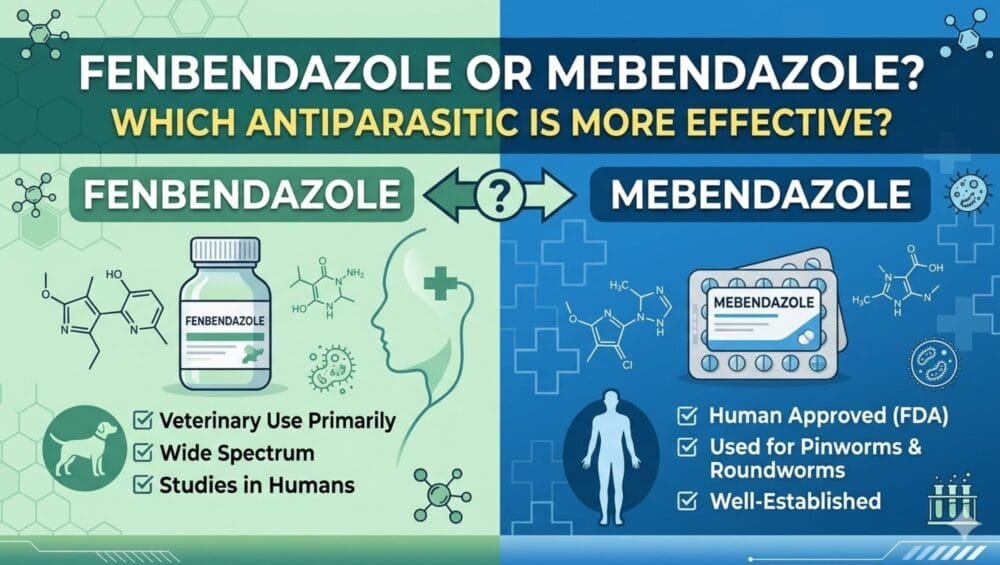
Millions of individuals worldwide suffer from parasitic illnesses, which can range from intestinal worms to more sophisticated parasitic organisms. Fenbendazole and mebendazole are two names that frequently surface in clinical and veterinary discussions on the best antiparasitic. Although each has special advantages, their functions, mechanisms, and populations differ.
To assist readers understand how these medications are used and why one would be chosen over another, we break down the science, compare effectiveness, explore usage scenarios, and touch on related chemicals, including larger community interest in ivermectin, in this blog.
Is Fenbendazole the Same as Mebendazole?
No, fenbendazole and mebendazole are not the same.
Both are antiparasitic medications from the same drug class (benzimidazoles) and work in similar ways by blocking glucose uptake in parasites. However, they differ in important aspects:
- Mebendazole is approved for human use and widely prescribed for intestinal worm infections
- Fenbendazole is mainly used in veterinary medicine and lacks standardized human dosing
- They are not interchangeable without medical guidance
For human parasitic infections, mebendazole is generally preferred due to stronger clinical evidence and regulatory approval.
Here is a quick comparison of fenbendazole vs mebendazole based on usage and effectiveness:
| Feature | Mebendazole | Fenbendazole |
|---|---|---|
| Human Use | Approved for humans | Mainly veterinary use |
| Common Use | Intestinal worm infections | Animal parasites |
| Clinical Evidence | Strong human studies | Limited human data |
| Interchangeable | No | No |
What Are Antiparasitics? A Primer
Antiparasitics, which fall under the category of anthelmintics, are medications that target parasite worms or organisms. These medications cause parasites to stop producing energy or using their reproductive systems, which ultimately causes the parasites to be removed from the host.
Typical human-oriented anthelmintics consist of:
- The mebendazole
- The drug albendazole
- The Prizantel
- Ivermectin (mostly used to treat certain worms, mites, and lice)
How Fenbendazole and Mebendazole Work Against Parasites
Fenbendazole Medicine
It is an antiparasitic widely used in veterinary medicine for animals and livestock. It interferes with the parasite’s ability to absorb glucose, effectively starving it. Because of this mechanism, fenbendazole shows activity against a range of intestinal worms and some protozoa.
Interestingly, in recent years, there has been increased public interest in off-label uses of fenbendazole, including discussions around combinations such as ivermectin fenbendazole tablets in experimental settings. However, it’s crucial to underline that uses outside approved indications must only be discussed with qualified healthcare providers.
Mebendazole
Mebendazole is a similarly acting anthelmintic approved for human use across many countries. It also disrupts glucose uptake in parasitic worms, leading to their degeneration and death. It’s commonly used to treat:
- Pinworm (Enterobius vermicularis)
- Hookworm
- Roundworm (Ascaris)
- Whipworm (Trichuris)
Often administered as a chewable tablet (e.g., mebendazole 100 mg), its safety profile and broad availability have made it a mainstay in human parasitic infection treatment.
Fenbendazole vs Mebendazole: Effectiveness Comparison
1. Spectrum of Activity
- Fenbendazole: Broad spectrum in veterinary parasites; also studied for activity against certain human intestinal worms, Giardia, and other protozoans. Its use in human medicine varies by region and clinical guidance.
- Mebendazole: Approved for a wide range of human intestinal helminths and frequently recommended in treatment guidelines.
Conclusion: For human clinical use, mebendazole typically has stronger evidence and regulatory backing. Fenbendazole’s activity is broader in some parasite types in animals but less established for human use.
2. Safety Profile
Both fenbendazole and mebendazole act selectively against parasites with minimal absorption in the human gut – a feature that contributes to safety.
However:
- Mebendazole has a long safety record in humans with established dosing regimens (e.g., mebendazole 500 mg dosage for adults depending on infection type).
- Fenbendazole is generally safe in animals but lacks the same volume of controlled human studies.
Whenever considering antiparasitic treatment, professional medical evaluation remains essential.
3. Dosing and Administration
- Mebendazole: Often given as a single dose or short course depending on infection type. Tablets like mebendazole 100 mg are standard in many regimens.
- Fenbendazole: Dosage in veterinary contexts is weight-based for animals; human use outside specific veterinary contexts is not standardized.
The Role of Ivermectin in Parasitic Treatment
What Is Ivermectin?
Ivermectin is another antiparasitic agent with a different mechanism. It binds selectively to nerve and muscle cells of parasites, leading to paralysis and death. Its high efficacy against certain parasites has made it invaluable, especially in:
- Onchocerciasis (river blindness)
- Strongyloidiasis
- Scabies and lice in specific formulations
Because of its effectiveness, products such as ivermectin 12 mg tablets are referenced often in clinical literature.
Public Interest and Context
In recent years, there has been increased public interest in products like fenbendazole and ivermectin tablets price, or experiences with ivermectin order online searches. It’s important to maintain clarity: while both drugs have legitimate antiparasitic uses, appropriate use must be guided by healthcare professionals and approved prescribing practices.
This blog does not provide purchase instructions or encourage individuals to source medication themselves. Always consult qualified medical guidance before considering any treatment.
Common Questions About These Medications
Can I take mebendazole and ivermectin together?
In some clinical contexts, combined therapy may be considered, but only under medical supervision. Interactions, safety considerations, and specific parasite targets must be evaluated.
Are fenbendazole and mebendazole interchangeable?
Not necessarily. They share similar mechanisms, but different regulatory approvals, spectra of activity, and human safety data mean they are not directly interchangeable.
Is ivermectin effective for all parasites?
No. Ivermectin targets specific parasites and is not a universal antiparasitic. For example, it’s effective against many nematodes and ectoparasites, but not all helminths or protozoa.
Fenbendazole vs Mebendazole: Effectiveness by Parasite Type
| Parasite Type | Mebendazole | Fenbendazole | Ivermectin |
| Pinworms | Yes | Variable | Some effect |
| Roundworms | Yes | Yes | Yes |
| Hookworms | Yes | Yes | Yes |
| Whipworms | Yes | Variable | Limited |
| Giardia | Limited | Yes | Not primary |
| Scabies/Mites | Not typical | Not typical | Yes |
Based on research contexts – not standard human prescribing.
How to Choose Between Fenbendazole, Mebendazole, and Ivermectin
Effectiveness depends on the type of parasite you need to treat.
- Consider whether the host is human or animal.
- Check regulatory approvals in your country.
- Review safety data and clinical evidence for each drug.
Doctors typically prefer mebendazole for human intestinal worm infections because it has well-established dosing and strong clinical support.
Fenbendazole lacks widespread human approval and standardized dosing but shows potential in veterinary use and specific research contexts.
Ivermectin works differently from mebendazole and fenbendazole. It efficiently targets certain parasites and ectoparasites but does not treat all worm infections.
Safety, Side Effects, and Professional Guidance
All medications carry the potential for side effects. For antiparasitics like mebendazole or ivermectin, side effects may include:
- Gastrointestinal discomfort
- Dizziness
- Temporary rash
- Rare allergic reactions
Fenbendazole’s safety in humans isn’t as well-established, which is why traditional medical guidance emphasizes approved human indications and dosing.
Important: This blog does not offer medical advice. If parasitic infection is suspected or diagnosed, consult a licensed healthcare provider for appropriate evaluation and prescribing.
Conclusion: Evidence, Effectiveness, and Practical Use
When comparing fenbendazole and mebendazole, the choice isn’t simply about potency – it’s about:
- Approved uses
- Clinical evidence
- Safety in humans
- Regulatory backing
Mebendazole remains one of the most widely recommended antiparasitics for human intestinal worms with a robust safety record. Fenbendazole holds value in veterinary medicine and in specific research contexts, but its use in humans remains limited without more extensive clinical evidence.
Meanwhile, drugs like ivermectin, including ivermectin 12 mg tablet forms, are essential for certain parasite types and have a long history of safe human use under medical supervision.
If you’re seeking to understand treatment options for parasitic infections, a healthcare professional should guide diagnosis, drug selection, and dosing – tailored to your condition and medical history.
Key Takeaways
1. Mebendazole treats human parasitic infections effectively.
Doctors commonly prescribe it for intestinal worm infections because it has strong clinical evidence and full human approval.
2. Fenbendazole primarily serves veterinary purposes.
It kills many parasites in animals, but doctors rarely use it for humans due to limited regulation and standardization.
3. Ivermectin attacks parasites differently.
It targets their nervous system and treats infections such as strongyloidiasis and scabies.
4. Parasite type determines drug effectiveness.
No single antiparasitic works for all infections, so healthcare professionals must diagnose correctly.
5. Always follow medical supervision.
Healthcare providers should guide the dosage and choice of antiparasitic medications.
Frequently Asked Questions (FAQs)
1. Which is more effective: fenbendazole or mebendazole?
For human intestinal worm infections, mebendazole is generally more established and clinically approved. Fenbendazole is primarily used in veterinary medicine and lacks broad human treatment guidelines.
2. What is the typical mebendazole dosage for adults?
The mebendazole 500 mg dosage for adults may be prescribed depending on the infection type. In some cases, mebendazole 100 mg is given twice daily. However, dosage should always be determined by a healthcare professional.
3. Can ivermectin be used with other antiparasitic drugs?
In certain medical cases, ivermectin may be prescribed alongside other medications. However, combinations such as ivermectin fenbendazole tablets should only be taken under medical supervision to ensure safety.
4. What factors affect mebendazole cost?
Mebendazole cost can vary based on brand, dosage strength, packaging, and region. It’s important to prioritize authenticity and professional consultation rather than price alone.
5.Is fenbendazole same as mebendazole?
No, fenbendazole and mebendazole are not the same. While both belong to the same drug class and work similarly, mebendazole is approved for human use, whereas fenbendazole is primarily used in animals and lacks standardized human treatment guidelines.
6. Is it safe to buy antiparasitic medicines online?
Many people search for terms like ivermectin buy online or mebendazole buy online, but purchasing medication should always involve licensed pharmacies and valid prescriptions to ensure safety and product authenticity.